AI Product Design
Talent Marketplace
Go-To-Market StrategyE
UX Strategy & Research
Cross-Functional Collaboration
Startup Product Development
CUSTOMER EXPERIENCE

Context & Overview
Project Summary
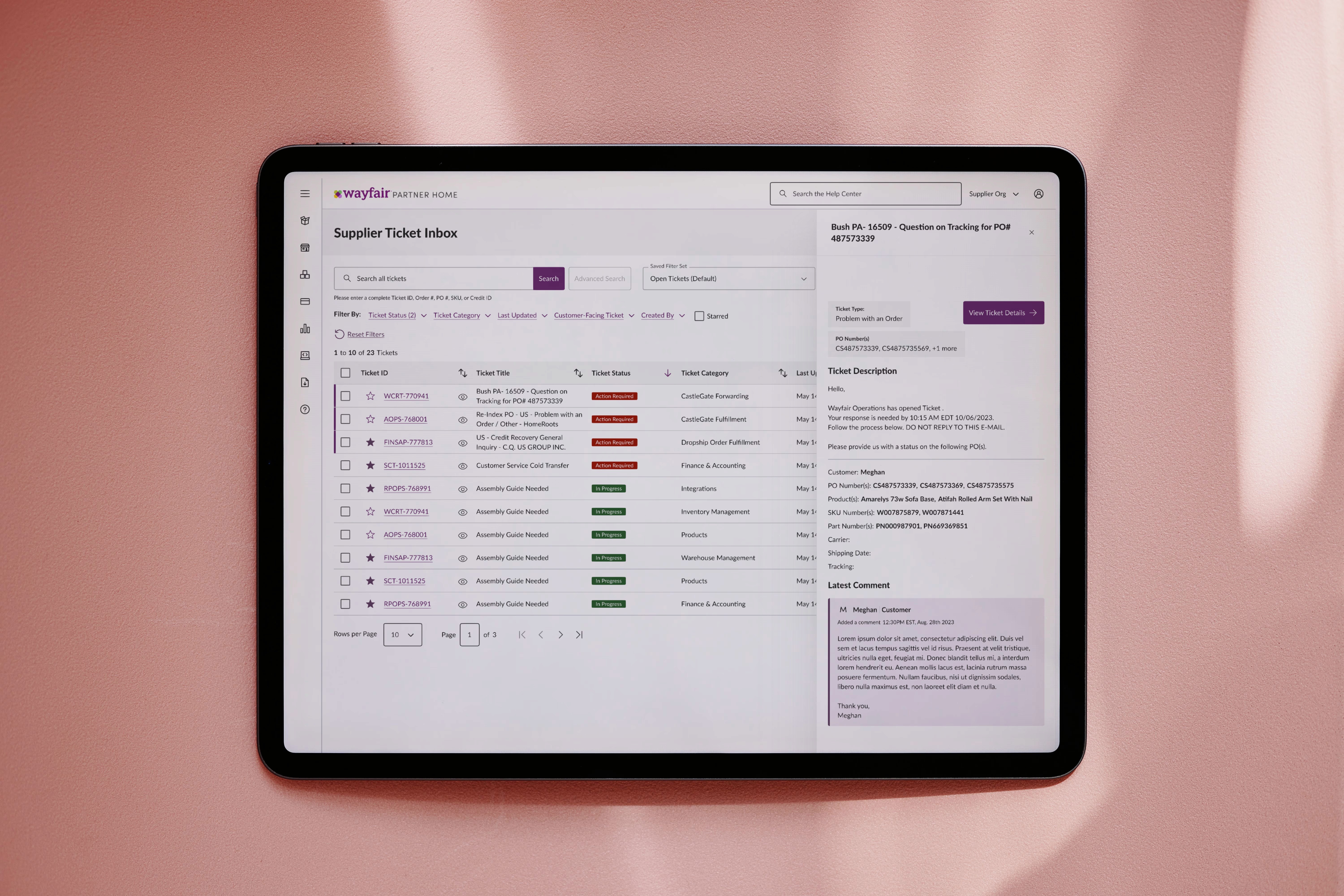
Wayfair’s Service Hub is the internal tool used by thousands of Customer Service (CS) agents to manage post-order contacts. While powerful, the experience had become fragmented and unintuitive, slowing down agent productivity and increasing training time. To reimagine Service Hub’s future, I led a 4-day Google Ventures (GV)–style design sprint with cross-functional partners at Wayfair's customer service centers in Athens, GA and Kingston, Jamaica. The goal was to observe agent interactions, define opportunities, rapidly prototype solutions, and test them live with service agents.
My Role
As a Wayfair customer service leadership team member and a design thinking consultant, I facilitated the sprint, set the strategic framing, and guided the team through ideation, prototyping, and testing. I partnered closely with CS Ops, Engineering, and Product leaders, while enabling my product design and UX research team members to own key pieces of the sprint process.
Timeline & Scale
The sprint ran over four days, involved 12 cross-functional participants, and generated actionable insights to inform a multi-quarter redesign of Service Hub impacting 5,000+ global agents and millions of annual customer contacts.

Challenge & Problem Statement
Business Context
Customer Service agents were spending too much time navigating fragmented workflows within Service Hub, contributing to high call handle times, inconsistent resolutions, and costly training programs.
Customer Impact
Inefficient tooling for agents directly translated into slower, less satisfying customer experiences.
North Star Metrics
Reduce agent contact handle time by streamlining workflows.
Improve speed to competency (shorten training ramp-up from weeks to days).
Enhance agent satisfaction, making Service Hub easier and more intuitive to use.
Constraints
Legacy systems limited immediate technical changes; the sprint had to focus on experience-level insights and validated concepts.


"
Agents weren’t struggling with effort — they were struggling with fragmentation. Our goal was to design one place where focus, guidance, and clarity finally came together.
Discovery & Research
Day 1: Ask the Experts
Conducted expert interviews with Ops leaders, senior customer service agents, and product managers.
Captured “How Might We” (HMW) opportunities on sticky notes, clustered into themes, and voted to identify high-priority areas.
Defined a long-term vision: “In 2 years, Service Hub should enable agents to resolve customer issues seamlessly, with automation guiding repetitive tasks and agents focusing on reassurance and complex problem-solving.”
Sprint Questions centered on:
How might we reduce agent friction across fragmented tools?
How might we support new agents in becoming productive within days?
How might automation and human support blend without eroding trust?

"
Our research revealed that agents didn’t need more tools — they needed one intelligent system that worked with them, not against them.
Design Strategy & Approach
Day 2: Ideation & Concept Selection
Facilitated lightning demos to draw inspiration from best-in-class tools.
Participants sketched concepts; team heat-mapped promising ideas.
Through straw polls and a final decider vote, we aligned on two prototype directions:
Unified Agent Dashboard: consolidating tasks, schedule, training, and customer interactions.
AI-Powered Assistant: contextual, in-line guidance during live contacts.
Day 3: Storyboarding & Prototyping
Created a 6-frame storyboard of the agent journey, from login to resolving a complex customer contact.
Built a high-fidelity prototype focused on:
Simplified onboarding flow.
Contextual automation within Service Hub.
Gamified training moments built directly into the workflow.


Execution & Collaboration
Established clear roles (facilitator, decider, note-taker, sketchers) to keep the sprint efficient.
Fostered cross-functional alignment: Ops prioritized business pain points, while Engineering clarified feasibility.
Created a testing plan with 5 agents, balancing recent hires and experienced agents to validate usability across various agent profiles.

Outcome & Impact
Day 4: User Testing
Tested and validated prototypes with 5 Customer Service agents.
Feedback highlights:
Positive: Agents valued the single dashboard view and reported it “felt intuitive and less overwhelming.”
Positive: The AI Assistant was praised for surfacing relevant guidance at the right time.
Negative: Agents wanted more customizability in dashboard widgets.
Achieved Business Impact post rollout:
Reduced onboarding and training ramp-up by ~44% through contextual learning.
Increased contacts per hour (CPH) by ~20% by simplifying various agent service workflows.
Improved agent satisfaction scores (measured by internal surveys) by 25+ points.